Understanding Filler Phrases
Filler phrases, often overlooked elements of communication, play a significant role in both conversations and written interactions. Common examples include “um,” “uh,” “you know,” “I mean,” among others. These phrases do not add meaningful content or clarity to the message being conveyed. Particularly in written forms of communication, such as emails, filler phrases can impede the professional tone and effectiveness of the message. They may also obfuscate the primary intent or dilate the impact that the writer wishes to convey. By actively working to remove these phrases from your communication, you contribute to producing content that is both clear and engaging.
Why Remove Filler Phrases?
The process of eliminating filler phrases from your writing, especially emails, holds numerous advantages that go beyond simple aesthetics. It is an exercise in enhancing the efficiency, professionalism, and clarity of your communication.
- Clarity: By stripping away unnecessary verbiage, the email becomes more straightforward and comprehensible, thereby allowing the reader to grasp your core message rapidly. This clarity is pivotal in ensuring effective communication, particularly in settings that require concise and accurate information exchange.
- Professionalism: A clear and direct communication style can positively impact your professional image. It signals to your audience that you are both competent and considerate of their time, enhancing your reputation as a clear thinker and communicator.
- Time Efficiency: Conciseness results in shorter emails, which not only saves your time but also respects your recipient’s time. This mutual efficiency can result in faster response times and more productive interactions.
Identifying Common Filler Phrases
The first step in the quest to clear your emails of filler phrases involves being able to recognize these phrases within your writing. Introduction phrases and wordings that do not add any substantive content are prime candidates for elimination. Common fillers that frequently appear in email communications include:
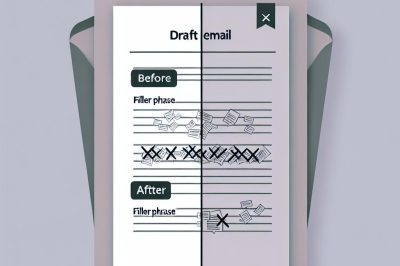
- “Just wanted to” – Example: Instead of expressing, “I just wanted to ask if you have any updates,” a more efficient way would be to say, “Do you have any updates?” This simple modification leads to a clutter-free sentence that directly addresses the question.
- “I think” or “I believe” – Example: In place of “I think we should meet,” adopting “We should meet” provides a more assertive and direct suggestion without appearing overbearing.
- “You know” or “Like” – These introduce ambiguity in written communication and can often be omitted without losing any part of your intended message.
How to Remove Filler Phrases
Aside from identifying filler phrases within your correspondence, intentional strategies to eliminate these phrases can optimize your emails for clarity and impact. Consider the following techniques:
- Edit Ruthlessly: Post composition, scrutinize your email for any redundant phrases or words. Thorough editing may require multiple reviews before all filler words are identified and removed. This practice refines your ability to spot unnecessary content over time.
- Practice Conciseness: Always focus on the central message of your email. Remove sections that stray from supporting this main message. Prioritize directness while ensuring politeness, as managing both effectively contributes to professional tone.
- Read Aloud: One effective way to catch filler phrases is by reading the email aloud. This method can reveal awkward or nonessential components that may not be readily apparent during silent reading. If a section sounds awkward or redundant when spoken, it’s likely dispensable in writing as well.
- Use Active Voice: Opting for active voice over passive voice enhances sentence strength using fewer words. For instance, transforming “The report was prepared by me” into “I prepared the report” can streamline communication, making it more engaging and efficient.
Conclusion
Embracing a consistent practice of recognizing and removing filler phrases within both spoken and written communication channels enhances the overall clarity, impact, and professionalism of your exchanges. For further development in effective email writing and communication skills, consider delving into professional writing resources or participating in workshops focused on concise communication techniques. To expand your understanding and improve your skill set, visit useful resources to elevate your professional correspondence systematically.